

Last Updated: November 20, 2026
Quick Summary
Print on demand is a fulfillment model where a supplier prints and ships products only after a customer places an order, so you never buy stock up front. You own your brand, store, designs, and customer relationships, while the supplier handles production and delivery.
- The global print-on-demand market is valued at $16.44 billion and projected to reach $118.85 billion by 2035.
- Start on a marketplace with free listings and order two or three samples before paying for a domain.
- Profit per item equals retail price minus production cost, shipping, and platform fees.
- Launch with two product types, not ten, and master mockups and sizing first.
- Follow a 30-day plan: setup and validation, designs and samples, listings, then marketing and review.
Table of Contents
- What Print on Demand Is and How the Business Model Works
- A Realistic Startup Budget for Print on Demand
- How to Start a Print on Demand Business With No Money
- Choosing a Niche and Target Audience That Can Actually Sell
- Demand Validation Before You Design a Single File
- The Best Print on Demand Products to Sell in 2026
- Creating Print-Ready Designs and Staying Legal
- Print on Demand Tools and Software You Need
- Choosing a Supplier and Managing Fulfillment Failures
- Comparing Ecommerce Platforms and Marketplaces
- Your First 30 Days: A Launch Plan
- Connecting Your Pop-Culture Store to The Hero's Closet
- Frequently Asked Questions
What Print on Demand Is and How the Business Model Works
The global print-on-demand market is valued at $16.44 billion and is projected to reach $118.85 billion by 2035, growing at roughly 25% a year, according to Printful's print-on-demand statistics. That growth is why so many people are starting print on demand for beginners as a side hustle. Print on demand is a fulfillment model where a supplier prints and ships products only after a customer places an order, which means you never buy stock up front (Print on Demand for Individuals and Brands). This guide from The Hero's Closet walks through the full workflow, the real costs, and a 30-day launch plan.
The Three-Step Fulfillment Loop
Every POD business runs the same loop: a customer orders from your store, your supplier prints and packs the item, and the supplier ships it directly to the buyer. You handle the storefront, designs, and marketing. The supplier handles production and delivery.
What You Actually Own (and What You Don't)
You own your brand, your store, your designs, and your customer relationships. You do not own inventory, machines, or warehouse space. That is the low-risk appeal of the model: no unsold stock sitting in a spare room.
A Realistic Startup Budget for Print on Demand
A print-on-demand store can be started with a modest budget, depending on whether you pay for a custom domain, a paid store plan, and sample orders. You never buy inventory up front. What most beginner guides skip is the actual math: what each line item costs, what a single order earns, and how many orders it takes to break even. This section gives you that worksheet.
Setup Costs: What You Actually Pay Before the First Sale
| Cost Item | Low End | Typical | Notes |
|---|---|---|---|
| Store platform | Free trial | Monthly plan | Marketplaces cost less than standalone stores |
| Domain name | None | Small annual fee | Optional on marketplaces |
| Design tools | Free tier | Subscription | Free tiers cover most beginners |
| Product samples | None | 2-3 items | Worth ordering before launch |
| Marketing | Organic only | Small ad budget | Start organic, add ads later |
A common pattern among beginners is to spend on a custom domain and a paid store plan in week one, before a single design has sold. That reverses the risk. Start on a marketplace with free listings, order two or three samples to check print quality, and only pay for a domain once a design has proven it can sell.
Unit Economics: A Worked Example
Profit per item = retail price minus production cost minus shipping minus platform fees. Run this calculation before you list anything. Here is how the math works for a typical apparel listing:
- Retail price: the amount the customer pays.
- Production cost: what the supplier charges to print the item.
- Shipping: what the supplier charges to deliver it.
- Platform fees: the marketplace or store commission plus payment processing.
If a shirt costs more to produce and ship than the price you charge, you lose money on it. Any amount above that cost is your margin. The trap is forgetting platform fees and payment processing, which can quietly eat a meaningful share of the sticker price. A listing that looks profitable at first glance can break even or lose money once every fee is subtracted.
Break-Even: How Many Orders Before You Are Whole
Break-even is total setup costs divided by profit per order. If your setup costs are modest and your profit per order is small, the number of orders needed to recover the setup investment is higher than most beginners expect. That is why the first goal is not a big launch but a small number of proven sellers. Once a design covers its own sample and listing costs, reinvest that profit into the next design rather than into ads.
Watch out: a supplier's base price can change, and a platform can adjust its fee structure. Re-run the unit-economics worksheet whenever either changes.
How to Start a Print on Demand Business With No Money
You can start a print-on-demand business with no money by using a marketplace with built-in traffic, free design tools, and a supplier that charges you only after a sale. The catch: your margins will be thinner and your brand control limited until you reinvest.
The sequence we recommend:
- Pick a marketplace that already has shoppers searching for your niche.
- Open a free design tool and create three to five simple designs.
- Connect a supplier that handles printing and shipping.
- Publish your listings with strong mockups and keyword-rich titles.
- Reinvest your first sales into samples and a custom domain.
A common mistake is spending on ads before you have a single organic sale. Prove the design works first.
Choosing a Niche and Target Audience That Can Actually Sell
The biggest mistake with niche selection is going broad. Generic "funny t-shirt" stores compete with millions of listings. New sellers asking whether the market is too saturated usually get the same answer: saturation is real at the generic level, but specific niches still sell, according to seller discussions on r/printondemand.
A workable niche has three traits:
- A clear audience with shared identity, such as a fandom, hobby, or profession
- Designs that speak to that identity in a specific way
- Enough search demand to sustain steady orders
Pop culture is a strong example. Fans buy apparel that signals belonging, which is why licensed-style and inspired designs move consistently. What most guides miss is that the niche decides your design language, your keywords, and your marketing channels all at once.
Demand Validation Before You Design a Single File
Validate demand before you spend hours on design files. Search your niche keywords on the marketplace you plan to sell on and look at what already sells. If top listings have steady reviews and sales signals, demand exists. If the top results look stale and generic, you have found a gap.
A simple validation checklist:
- Search 5 keyword variations for your niche
- Note the top 10 listings and their review counts
- Confirm at least 3 listings show recent sales activity
- Check whether designs are generic or specific
- Decide if your angle is different enough to compete
This step takes an afternoon and saves weeks of wasted design work.
The Best Print on Demand Products to Sell in 2026
Apparel and accessories are a common starting point for print-on-demand sellers, because products like t-shirts and hoodies let designs carry identity. Apparel dominates because fit and print area give you room to design.
Apparel and Accessories: What Moves and What Sits
T-shirts move fastest. Hoodies carry higher margins but sell seasonally. Hats and tote bags are steady accessories with lower competition. What sits: oversized niche items with no clear audience and products where print quality is hard to control.
Our advice: launch with two product types, not ten. Master mockups and sizing on those before expanding your product range.
Creating Print-Ready Designs and Staying Legal
Print-ready files are high-resolution designs sized to the supplier's template, usually with a transparent background and correct dimensions. Most suppliers publish exact specs, and ignoring them is the fastest route to rejected or blurry prints.
Copyright, Trademarks, and Licensing Basics
This is the section most beginner guides skip, and it is the one that can end your store overnight. Copyright covers original artwork. Trademarks cover brand names, logos, and slogans. Selling a design that uses a protected character, logo, or phrase without a license exposes you to takedowns and legal claims.
The safe path is officially inspired or licensed-style designs from a supplier that handles the licensing question for you. If you create your own art, avoid anything that reads as a direct copy of a protected property. When in doubt, do not list it.
Print on Demand Tools and Software You Need
The print-on-demand tools and software you actually need are few: a store platform, a design tool, a supplier integration, and a basic analytics view. Everything else is optional until you scale.
Your core stack:
- Store platform: marketplace or standalone store with supplier integration
- Design tool: free tier is enough to start
- Supplier dashboard: for orders, tracking, and product templates
- Analytics: built-in platform stats cover the early stage
Skip the expensive automation suites until order volume justifies them. A common mistake is stacking subscriptions before the first sale.
Choosing a Supplier and Managing Fulfillment Failures
Choose a supplier on print quality, fulfillment speed, and how they handle problems, not on catalog size alone. Order samples first. A supplier that prints well but ships late will cost you customers. What most guides leave out is how to test a supplier systematically and what to do when an order goes wrong. This section gives you a repeatable scorecard and a failure-handling process.
A Sample-Testing Scorecard
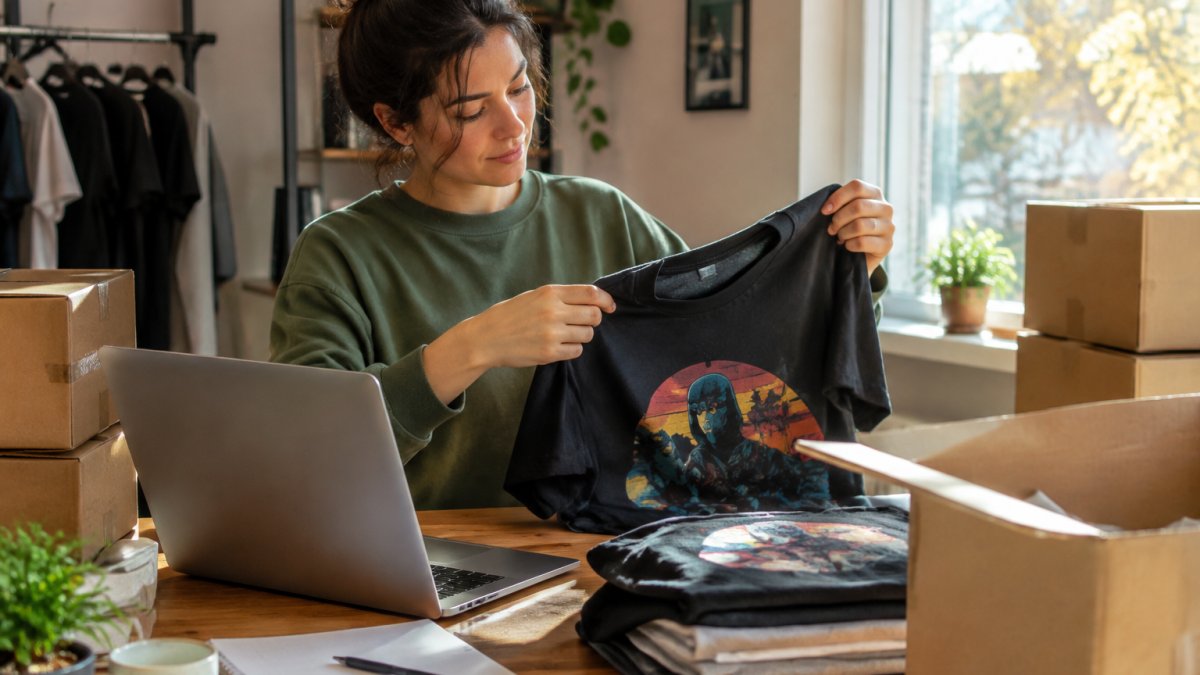
Order one sample of each product type you plan to sell, then score it on the same criteria every time so you can compare suppliers side by side:
- Print sharpness: are fine lines and small text crisp, or blurry and faded?
- Color accuracy: does the print match the file, or is it washed out or oversaturated?
- Placement: is the design centered and sized correctly on the garment?
- Material feel: does the fabric or substrate feel like something a customer would keep?
- Wash durability: does the print survive a few normal washes without cracking or fading?
- Packaging: does the item arrive clean, folded, and undamaged?
- Delivery time: how many days from order to doorstep, and does it match the supplier's stated window?
Score each item on a simple scale and keep the notes. A supplier that scores well on print but poorly on delivery time is a different risk than one that ships fast but prints inconsistently. The scorecard turns a vague 'order samples' instruction into a decision you can defend.
Handling Fulfillment Failures
Fulfillment failures happen. Misprints, delayed shipments, wrong sizes, and lost parcels are part of the model. The fix is a clear process, not a hope that it will not happen:
- Respond to the customer fast. A quick acknowledgment buys patience; silence turns a small delay into a refund request and a bad review.
- File a claim with the supplier. Most suppliers have a claims window and require photos of the defect. Keep the process and the evidence in one place.
- Reship or refund. Decide based on the supplier's policy and the customer's preference. A reship protects the review; a refund closes the case.
- Log the failure. Record the order, the supplier, the failure type, and the resolution.
Track failure rates per supplier over time. A supplier that keeps missing on the same product type is a pattern, not bad luck. Drop the one that keeps missing, even if its base price is lower, because the cost of a repeated failure is a lost customer and a public review.
Watch out: a supplier can change its production partner or shipping carrier without announcing it. Re-test with a fresh sample after any noticeable shift in delivery times or print quality, or you may discover the change through customer complaints instead.
Comparing Ecommerce Platforms and Marketplaces
Marketplaces and standalone stores solve different problems. Marketplaces bring built-in traffic and search, which is why they are frequently recommended for beginners. Standalone stores give you brand control, better margins, and full customer data, but you supply the traffic.
| Option | Best For | Trade-off |
|---|---|---|
| Marketplace | Beginners wanting built-in traffic | Thinner margins, less brand control |
| Standalone store | Brand builders with marketing skills | You drive all traffic |
| Hybrid | Sellers ready to scale | More setup and management |
Start on a marketplace to validate designs, then consider a standalone store once you have proven sellers.
Your First 30 Days: A Launch Plan
A practical first 30 days looks like this: week one for setup and validation, week two for designs and samples, week three for listings and soft launch, week four for marketing and review.
- Days 1-7: pick niche, validate demand, open accounts
- Days 8-14: create 5-10 designs, order samples, set up store
- Days 15-21: publish listings, write keyword-rich titles, launch to your network
- Days 22-30: post on social media, review sales data, double down on what sells
The goal is not perfection. It is a live store with real orders and real feedback by day 30.
Connecting Your Pop-Culture Store to The Hero's Closet
If your niche is pop culture, the supplier decision matters more than the platform decision. At The Hero's Closet, we offer officially inspired designs from Marvel, Disney, Pixar, and Star Wars, with custom designs, fulfillment, and direct shipping to your customers.
Ready to build your store? Contact our team to get set up with designs and fulfillment.
The hardest part of starting print on demand is not the setup, it is picking a supplier you can trust with your customers. The Hero's Closet handles officially inspired designs, custom products, fast fulfillment, and direct shipping, so you can focus on marketing while we handle production. Get started with The Hero's Closet and launch a store your fans will actually wear.
Frequently Asked Questions
What sells most on print-on-demand?
Apparel leads the category, especially t-shirts and hoodies, because sizing is forgiving and designs are easy to swap. Accessories like mugs, tote bags, and phone cases sell well as add-ons. The real driver is not the product category but how specific the design is to a recognizable audience. Generic quotes compete on price; niche-focused designs sell on identity, which protects your profit margin.
How much money do I need to start print-on-demand?
You can launch with very little because there is no inventory to buy upfront. The costs that matter are a store subscription, a domain, sample orders to check quality, and a small ad budget if you plan to drive traffic. Your unit economics matter more than the total: know your production cost, shipping, and platform fees before you set a retail price.
Is print-on-demand still worth it in 2026?
Demand for print-on-demand products is substantial. Worth it depends on your approach. Sellers who pick a specific niche, validate demand before designing, and treat customer service seriously can build steady sales. Sellers who upload generic designs to a marketplace and wait will struggle against saturation. The model rewards focus and consistency more than volume.
Can you start print-on-demand with no money?
You can start with almost nothing by using a marketplace that has built-in search traffic, designing with free tools, and ordering your first sample only after you make a sale. The trade-off is slower growth and less control over branding. A no-money start works best when you reinvest early profits into samples, a domain, and better mockups. Avoid paid ads until you have at least one design that has sold organically, so you know the demand is real.
How do I choose the right print-on-demand supplier?
Order samples first and judge the print quality, fabric feel, and wash durability yourself. Check fulfillment times and where production happens, because shipping distance affects delivery promises. Read the supplier's policy on misprints and returns, and ask about any minimum volume requirements before you commit.
What are the biggest risks when starting a POD business?
The main risks are copyright and trademark violations, supplier quality failures that damage your reviews, and thin margins that leave no room for ad spend. Saturation is a real concern, but it hits generic products hardest. Protect yourself by using original or properly licensed designs, ordering samples before listing, and calculating your profit margin per item before you set prices. A written fulfillment agreement with your supplier covers the operational risk you cannot inspect yourself.
